
Where CWC Releases Go
A completed CWC sentence can end with a return to the community. The person may have no further supervision, may begin or continue court probation, or may enter a form of state felony supervision. Another hold can change that path. CWC may also transfer a person instead of discharging the person to the community. The movement destination matters as much as the date.
Work release is different. It allows approved off-site work or activity while the sentence and custody continue. Seeing someone away from the center during an approved period is not evidence that confinement has ended. Ask CWC whether the event was a final discharge, an authorized work-release movement, or a transfer. The sentencing court can then confirm sentence completion, jail credit, probation, or another controlling order.
| CWC status | Community release? | Confirm with |
|---|---|---|
| Final sentence completion | Usually, unless another hold applies | CWC discharge and court judgment |
| Work release | No, lawful custody continues | CWC program status |
| Local probation | Physical release with court supervision | Court order and county probation |
| TDOC transfer or supervision | Depends on the recorded destination | CWC record and TDOC FOIL |
Confirm a CWC Release
CWC has no researched public recent-release feed. A broad search of county inmate-service links cannot establish a CWC discharge. Start with the facility because it held the person. Be specific about the movement being requested, then use the court or TDOC only for the part each agency controls.
- Collect the person's full name, date of birth, sentencing case number, and likely date range.
- Call CWC at 615-898-7847 and ask for the office that maintains discharge and movement records.
- Request the actual discharge or transfer date, type, and destination. State whether work-release status must be distinguished from final discharge.
- Obtain the judgment or final disposition from General Sessions Criminal or Circuit Criminal, as appropriate.
- Search TDOC FOIL only if state felony custody or supervision is part of the history.
A FOIL status of probation or parole means the person is in the community under state legal control. Inactive is a clue about TDOC status but should be read with sentence and release information. Incarcerated means TDOC custody continues. None of those fields replaces CWC's record of the moment the person left this county facility.
Note: FOIL answers TDOC status questions, while CWC remains the record holder for its own discharge or transfer event.
CWC Release Records Contact
The official Correctional Work Center page provides the center's location, main number, fax, and lobby hours. Call before visiting because the researched source does not name a separate public records clerk or publish a dedicated online CWC discharge form. Ask the center to identify the proper custodian for the requested movement record.
Rutherford County Correctional Work Center
1720 South Church Street
Murfreesboro, TN 37130
615-898-7847
Fax: 615-898-7837
Lobby: 8 a.m. to 4 p.m. daily, closed 11 a.m. to noon on Saturday and Sunday
A useful request names one person and one date range. Ask for admission to CWC, actual discharge or movement time, release type, destination or receiving authority, sentence or booking identifier, and the office that authorized the movement. Request an electronic copy and a cost estimate. Do not assume that every internal field is public, that a reply date equals production, or that an adult Sheriff release form automatically covers CWC records.
CWC Programs and Custody
CWC is a county correctional center for sentenced people. Its mission emphasizes a lawful return to the community through structured education, substance-use programming, community work crews, and work-release opportunities. Those services support transition, but program participation is not a release record. The precise legal status still comes from the sentence, facility movement, and any supervision order.
The county's official CWC source shows the mission, work-release description, contact details, and lobby schedule used here.
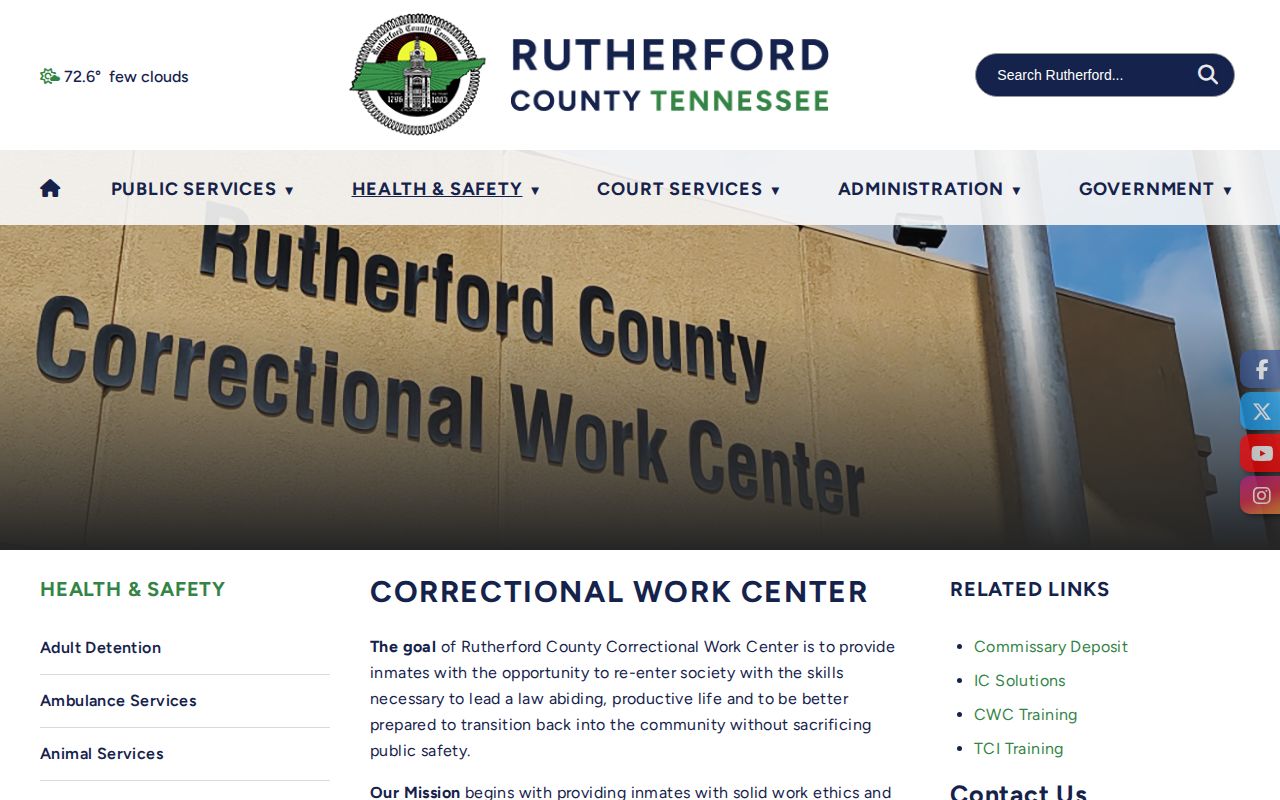
The source confirms that CWC is a separate sentenced and work-release setting, not the Sheriff's main adult jail or a public release feed.
TDOC's FY2025 statistical abstract represents the facility as Rutherford County WH and reports it separately from Rutherford County Jail. The cited table includes a total of 208 for the WH row, but that figure is a table population category, not a capacity, annual release count, or current head count. Its safe use is to show that state data also recognizes a separate workhouse track.
Rutherford CWC Discharge Fields
A focused CWC request should distinguish admission, temporary program movement, transfer, and final discharge. Ask for the date and time the person entered CWC, the actual movement timestamp, the recorded movement type, and the destination or receiving authority. Include the sentencing case number and any facility identifier that staff can use to match the correct person. If the person took part in work release, state plainly that the request seeks the later event that ended or transferred custody.
The court file supplies a different set of facts. It can show the judgment, sentence, jail credit, probation terms, revocation history, and final disposition. Those fields explain the legal basis but may not show the exact time CWC processed the movement. When the facility and court dates differ, preserve both. Ask CWC about the physical event and the clerk about the court record rather than treating one as an error in the other.
- Discharge
- The recorded end of CWC custody, subject to any other hold.
- Transfer
- Movement to another custodian while confinement continues.
- Work release
- Approved activity outside the center while legal custody remains.
- Final disposition
- The court's recorded outcome, which is separate from the gate timestamp.
Rutherford Adult Release Tracks
Rutherford County has two adult custody paths. The Sheriff's Adult Detention Center holds a mixed pretrial and sentenced population. CWC focuses on sentenced custody and structured transition. Moving from ADC to CWC is a transfer between local facilities, not a community release. Leaving CWC for approved work can also occur while confinement continues.
This local split is why one roster or phone call cannot answer every question. Contact Sheriff records for an ADC event and CWC for a work-center event. Then use the same court case to explain the legal authority. The Rutherford County released inmate lookup lays out the broader county, state, and federal sequence when the last custodian is uncertain.
Note: TDOC's separate Jail and WH rows describe custody categories, not current release totals or proof of discharge.
CWC Discharge and Court Records
The facility record proves physical movement. The court record explains sentence terms. General Sessions Criminal handles misdemeanor matters. Circuit Criminal handles felony-level proceedings, and the Circuit Court Clerk processes final dispositions. A case record may preserve the sentence, jail credit, probation order, revocation, and completion. It may not state the exact CWC gate time.
Rutherford's online dockets are informational only. Updates or changes appear on the original, and sealed cases are omitted. Obtain an original or certified disposition when durable proof is needed. A sentence marked served can coexist with probation or another case. Discharge from supervision is a later event than release from CWC and should not be inferred from the facility movement alone.
CWC Release to Supervision
Local court probation and TDOC supervision are separate systems. Rutherford County Probation and Recovery Services handles people placed on probation by local courts. Its case-manager page instructs a person just released or unsure of an assignment to call 615-849-5720 and press 0. Reporting times are set for each person, so public office hours do not replace a direct reporting instruction.
TDOC administers state felony parole and probation. FOIL may show the status and assigned location. The Tennessee Board of Parole makes parole decisions, while TDOC supervises a person after release. Pretrial Services is different again: it is voluntary, nonmonetary conditional release while charges remain pending. CWC discharge records should be matched to the exact supervision order rather than labeled with a broad term.
CWC Transfers and Detainers
Another warrant or detainer can prevent a planned sentence end from becoming community release. Ask CWC whether the destination field names another county, TDOC, a federal authority, or ICE. A computed sentence date does not cancel a separate legal hold. The actual movement and the receiving authority's record are stronger evidence.
If ICE receives the person, county release and immigration custody are two events. Search the ICE locator only for its own custody window and use the CWC record for the county handoff. Research found no authoritative basis for claiming a Rutherford institutional ICE contract, so an individual detainer should not be expanded into a claim about the facility as a whole.
Note: A CWC sentence-end calculation does not cancel a valid detainer or establish that the next destination is the community.
Rutherford CWC Re-Entry Connection
Rutherford County says its Re-Entry Program began in 2019 at both CWC and ADC. Full programming is designed for people serving at least three months, while resource connection is available to all people affected by incarceration. The program can help navigate local resources, but it does not certify a discharge, calculate a sentence, or change supervision terms.
The Re-Entry Program is at 525 North University Street and can be reached at 615-217-7124. Its connection to both adult facilities is useful when a person moves through more than one local custody track. Legal proof still comes from CWC for the physical movement, the court for the sentence and disposition, and TDOC when state custody or supervision is involved.