
Rutherford Projected Versus Actual Release
A projected date is a forecast based on the sentence record available at that point. An actual release date records an event that has already occurred. TDOC's forms make this distinction clear by separating Sentence Expires, Release Eligibility, Safety Valve Date, Max Sentence, and Date of Release. FOIL's exact public label is Release Eligibility Date. It is the earliest point at which parole consideration may occur under the governing sentence, not a promised exit date.
The Rutherford County jail population includes both pretrial detainees and sentenced people. A pretrial person has no sentence from which to compute a projected date. Bond, a Judicial Commissioner decision, dismissal, a court order, or another custody claim can determine the next event. A sentenced ADC or CWC person may have a county calculation. Someone sentenced to state custody may remain in a county facility as a state-backup prisoner before transfer to a TDOC institution outside Rutherford County.
- Release eligibility
- The first lawful point for parole consideration under the applicable sentence.
- Sentence expiration
- The computed end of the sentence, subject to controlling records and law.
- Detainer
- A request or legal hold from another authority that can change the destination at release.
- Actual release
- The recorded time custody ended or moved to another authority.
Find Rutherford Projected Release Dates
The correct lookup follows custody. For a Tennessee felony prisoner, use the TDOC FOIL search. It covers current and former felony offenders in TDOC custody or under supervision. Search by exact name, with aliases if needed, or use a TDOC/TOMIS ID or SID. A state record does not cover every local misdemeanor, bond-out, or county sentence.
For an ADC or CWC sentence, start with the court judgment. It supplies sentence length, sentence-effective date, and jail credit. Then ask the facility for its current calculation and any posted credits. A county court is the legal source for the judgment, while the jail or work center is the source for its physical movement record. A state case needs TDOC's computation, even if the person is temporarily held in Rutherford County.
- Identify ADC, CWC, TDOC, federal, or immigration custody. Do not treat a missing local result as a release.
- Obtain the judgment, sentence-effective date, jail credit, and whether terms run at the same time or in sequence.
- For TDOC, search FOIL and match identifiers before reading Release Eligibility Date and Sentence End Date.
- For local custody, ask ADC or CWC for the current release calculation tied to that judgment.
- Ask the calculating agency whether earned credits, discipline, court amendments, or parole action are fully posted.
- Check warrants, detainers, and the “released to” destination before assuming community release.
- After the event, obtain the actual release or transfer timestamp from the facility or TDOC record.
The live FOIL interface displays the name, identifier, alias, and race controls used to locate the correct state record.
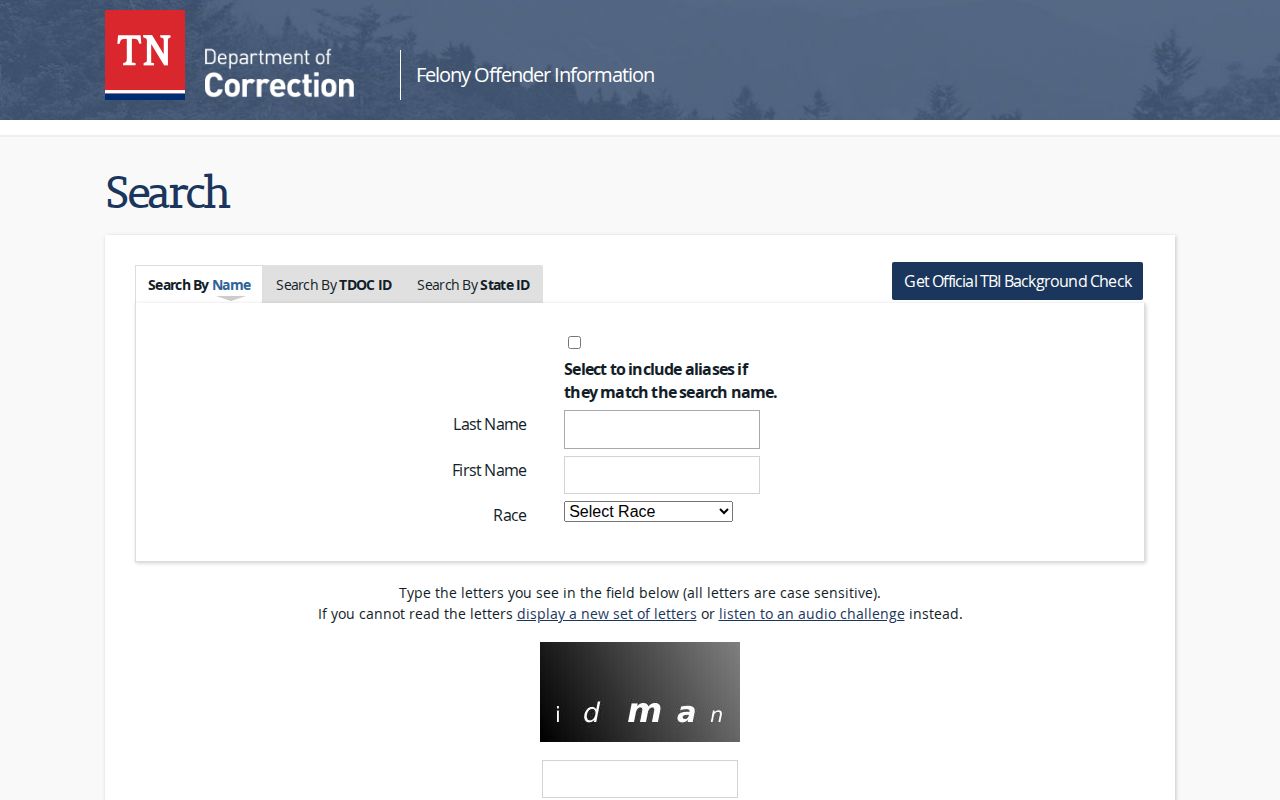
Those search fields reduce mistaken matches before any date or sentence result is interpreted.
Note: FOIL warns that dates may change as more court documents arrive, so save the date checked and verify later updates.
Rutherford FOIL Release Date Fields
FOIL does not use a vague “projected release” label. Its detail record can show Release Eligibility Date, Sentence End Date, Sentence Begin Date, Combined Sentence(s) Length, Supervision Status, Assigned Location, Supervision/Custody Level, Parole Hearing Date, Parole Hearing Result, and Active Tennessee Sentences. Read those labels as separate facts. The eligibility date concerns parole consideration. The sentence-end field concerns the computed term. The hearing result concerns Board action.
The FOIL detail view captured for this project shows the exact Release Eligibility Date and Parole Hearing Result labels.
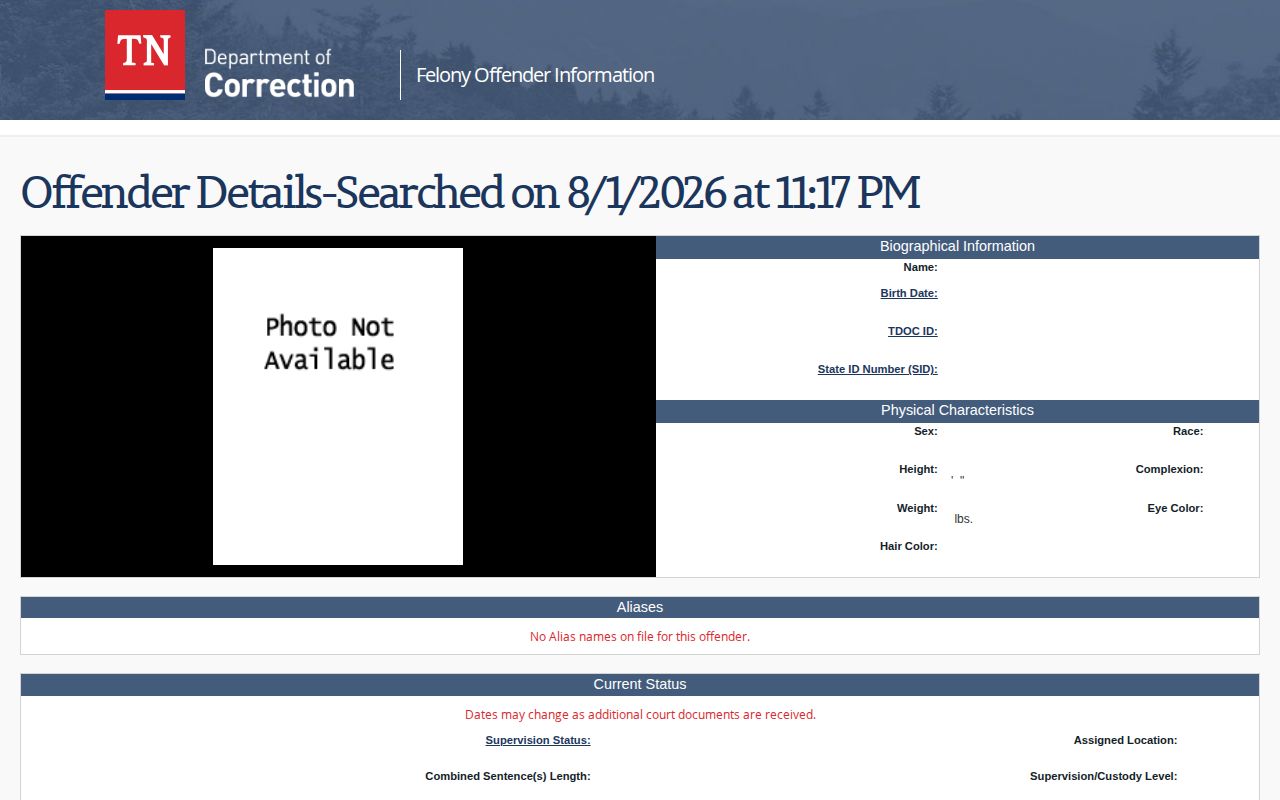
Reading both labels prevents a hearing event from being mistaken for an approved or completed release.
| FOIL field | What it answers | What it does not prove |
|---|---|---|
| Release Eligibility Date | Earliest point for parole consideration under the sentence | A fixed gate date or Board grant |
| Sentence End Date | Computed sentence endpoint in TDOC data | Destination or exact release time |
| Parole Hearing Result | Recorded result of an individual parole proceeding | That all prerelease steps are complete |
| Supervision Status | Whether TDOC control may continue in the community | Final discharge from every legal obligation |
Rutherford Earned Credit Rules
Tennessee credits are earned, not automatic. Under Tenn. Code Ann. §41-21-236, the statutory range can total one to sixteen days per month. Up to eight days may relate to good institutional conduct and up to eight to satisfactory program performance. Review, loss, and restoration rules apply. The statute also addresses qualifying felony offenders serving at least one year locally and documented presentence good-behavior credit.
Local misdemeanor treatment is not the same as a TDOC felony calculation. Section 41-21-236(f) permits the sentencing court to set a release percentage from listed increments and limits how credit changes that percentage. ADC also states that qualifying trusties can work off one sentence day for each day of labor under state law. Trusty status, eligible work, discipline, and the court's sentence facts matter. Ask jail records for the calculation used in the specific case instead of converting that statement into a universal formula.
For felony eligibility, Tenn. Code Ann. §40-35-501 varies by offense, offense date, range, and sentence. Examples within the statute include 20 or 30 percent for especially mitigated classifications, 30 percent for Range I standard offenders, 35 percent for Range II multiple offenders, 45 percent for Range III persistent offenders, and 60 percent for career offenders. Credits and exclusions still must be applied under the controlling subsection.
Note: The sentencing judgment and the responsible agency's computation control; a general online calculator cannot account for the full Rutherford County record.
Rutherford Release Percentage Limits
The phrase “85 percent rule” is not a safe statewide shortcut. Section 40-35-501(y) applies to listed offenses and controlling offense dates. For specified offenses committed from July 1, 2021 through June 30, 2024, eligibility does not occur before 85 percent and credits cannot reduce service below that floor. For the same specified offenses on or after July 1, 2024, the law keeps an 85-percent framework with defined credit treatment.
Other offenses under subsection (aa) require 100 percent service, with credits allowed only for limited institutional purposes rather than sentence reduction. Post-July 1, 2024 provisions in §40-35-501(ff) and §41-21-236 also distinguish qualifying felony sentences of at least two years: credits may affect the percentage to parole eligibility without changing sentence expiration. Earlier offenses and shorter terms can operate differently.
Consecutive sentences require separate computation and aggregation under subsection (m). Subsection (n) describes eligibility as the earliest parole-eligible point conditioned on behavior and subject to deferral after rule violations. That is why the offense statute, offense date, range, and sentence structure must be checked before any percentage is stated for one Rutherford County case.
Why Rutherford Release Dates Change
A release calculation can move when the source data or legal conditions change. TDOC says dates may change as additional court documents arrive. County calculations can also change when the sentencing court amends a judgment or a facility posts credit and discipline. The reason should be traced to the agency record, not guessed from an older screenshot.
| Factor | Possible effect on the date or destination |
|---|---|
| Earned credit | May advance eligibility or affect service when the governing statute allows it |
| Disciplinary loss or restoration | Can remove or restore credits after agency review |
| Jail credit | Changes the credited time already served before the sentence computation |
| Amended court judgment | Can change the sentence-effective date, length, or concurrent and consecutive structure |
| Parole action | A denial or deferment can leave confinement in place; a grant still requires prerelease steps |
| Warrant or detainer | Can cause transfer to another authority instead of community release |
| Statutory exclusion | Can set an 85-percent or 100-percent floor for a qualifying offense and date |
A detainer deserves special attention. TDOC's release checklist calls for warrant and detainer review, release-plan approval where applicable, and identification of the release type. The release authorization also includes a “Released to” field. That destination field can matter more than the forecast because a move from TDOC may begin local, federal, or immigration custody rather than freedom in the community.
Rutherford Parole and Release Dates
Parole eligibility is the first point when discretionary release may be considered. It is not an order. The Tennessee Board of Parole publishes current hearing information through its Hearings Division, with schedules updated weekly and available by email request. Hearing officers make recommendations, while Board members complete the decision under the vote rules that apply to the matter.
A favorable recommendation remains nonfinal. Board Operations handles final decisions, and the Certificate Unit prepares a parole certificate after a grant. An approved release plan and detainer resolution may still be required. FOIL's Parole Hearing Result should therefore be read beside Release Eligibility Date, supervision data, and the later actual release transaction.
If parole occurs, the unexpired sentence may continue under TDOC community supervision. Physical departure from prison is not final discharge. The Rutherford County post-release supervision page separates TDOC parole from county probation and explains the correct Murfreesboro office routes.
Confirm Rutherford Actual Release Dates
Finish with an affirmative event record. For ADC, call the Sheriff's main line and submit its current public-record request form for the actual release or transfer date, time, type, and destination. For CWC, call 615-898-7847 and ask which office holds the movement or discharge record. Pair that response with the court judgment when the legal reason matters.
For TDOC, check FOIL after the expected event and request older material through TDOC Records Management if needed. The department's release authorization includes the actual date, release type, released-by and released-to data, plus property and identification acknowledgments. Archive questions go to 615-253-8079. VINELink can send a reported custody-change alert, but an alert is not a certified release record and may lag agency processing.
Keep custody systems separate. A county-jail transfer to TDOC is not community release. A TDOC release on a detainer may start custody elsewhere. A federal BOP date only ends BOP custody, and immigration movement requires the ICE route. The broad county search and records-request sequence is available on the Rutherford County released-inmate lookup.